Author: Joe Zhou, Foresight News
Original Title: Myanmar Under War: The Dignity of the US Dollar, Trapped Youth, and the Underground Financial Market
During the 2026 Spring Festival holiday, I traveled to Myanmar for a two-week field research trip.
Passing through Yangon, Bagan, and Mandalay, I attempted to uncover the true economic, financial, and social survival conditions of this country under the shadow of war. As the first record halfway through the journey, this article will showcase the real Myanmar I witnessed.
Just in the first week in Yangon, the overwhelming density of information far exceeded my imagination:
A 9-year-old child who dropped out of school to work as a waiter, middle-aged men who could be forcibly conscripted at any moment, young people unable to obtain passports to leave the country, and foreigners who come here to "buy wives" taking advantage of the economic disparity...
In Yangon, under warlord control, bars and KTVs still maintain the illusion of a vibrant nightlife; while in many other cities across Myanmar, once the 7 p.m. curfew hits, the streets instantly fall silent, as if becoming a dead city, devoid of any human presence.
This is a vast, folded system. War and corruption grow in the cracks, and soaring prices are pushing ordinary people's lives to the edge.
The Folded Myanmar
To understand this撕裂 (tear/rift), one must first see the three layers of "folding" present in this country.
There are two Myanmars: one is the Myanmar under the internet filter, the other is the Myanmar in reality; one is the Myanmar whitewashed in official data sheets, the other is the Myanmar struggling in the black market.
The first fold is the profound exchange rate裂痕 (crack/fissure). Upon landing in Myanmar, I exchanged 2500 Chinese Yuan for 1.38 million Myanmar Kyat at a Chinese restaurant. The official rate boasts 1:300, while the real trading price on the black market has plummeted to 1:550.
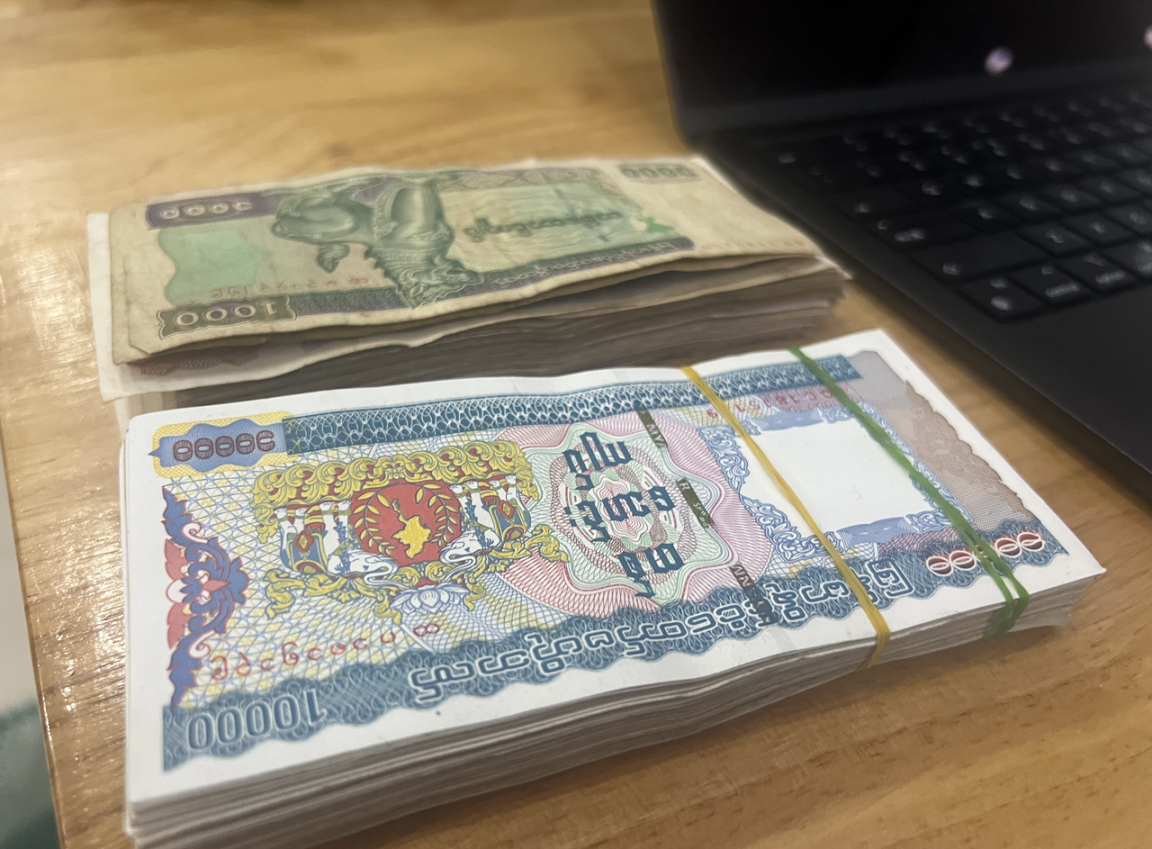
1.38 million Myanmar Kyat exchanged by the author
The national exchange rate is nominal, the black market rate reflects the people's reality.
The second fold is the cliff-like disparity in wages. A waiter doing the same job earns around 18,000 Chinese Yuan per month in Hong Kong, 8,000 in Shanghai, while in Bagan, Myanmar, this number plummets to a suffocating 300 Yuan.
Even within Myanmar, the urban-rural gap remains huge. An overseas Chinese long settled in a town told me that a waiter's monthly salary in a big city can reach 500 to 800 Yuan—this implies that even the highest-paid low-wage earners in Myanmar receive only about one-tenth of what their counterparts in Shanghai earn.
The third fold is the demonized internet labels versus the simple and honest reality. On the Chinese internet, Myanmar is simplistically and crudely reduced to synonyms for "kidney harvesting" and telecom fraud. But when you actually walk the streets of Yangon, Bagan, and Mandalay, you find that most people here still maintain extreme simplicity and peacefulness. Northern Myanmar is indeed dangerous, filled with war and grey industries, but essentially, those crimes have nothing to do with the vast majority of ordinary Myanmar people—in this grand geopolitical and interest meat grinder, they are equally the most helpless victims.
The "Dignity" of the US Dollar
This underlying economic裂痕 (crack/fissure) and sense of insecurity is most absurdly manifested in the currency.
Myanmar's underground financial market operates on an iron rule: US dollars must not be folded; any bill with marks or damage is rejected.
The economic常识 (common sense) that "a trampled $10 bill still has value" completely失效 (fails/loses effect) here. Even the slightest crease can cause the bill to be mercilessly refused by vendors. Every Myanmar person I've seen handling US dollars acts like a merchant examining an expensive antique with a magnifying glass; they hold their breath, carefully scrutinizing every inch of the bill's edges, every hidden line.
In stark contrast is the treatment of the local currency—the Myanmar Kyat can be crumpled into a ball, stuffed into a pocket, even thrown into water for a wash, taken out and still spent; but the US dollar must remain perfectly crisp. In the local subconscious, a damaged US dollar is equivalent to gold of inferior quality, subject to a 10% to 20% discount penalty.
This近乎病态的 (almost pathological) "fastidiousness" is precisely a concrete manifestation of the extreme fragility of this country's financial system. Long-term sanctions and complete financial isolation have driven the official and black-market exchange rates to an extreme撕裂 (tear/rift). In this country that has lost all sense of security, the dignity of a green piece of paper is infinitely elevated; the respect it commands甚至远远超越 (even far surpasses) that of a sweating, struggling living person.
5 Bottles of Water Equal an Adult's Daily Wage
The collapse of monetary信用 (credit/trust) directly translates into runaway inflation. With the war持续多年 (lasting many years), Myanmar's prices have become disordered.
In the memory of local Kosla, over the past decade, the price of most goods in Myanmar has soared about 5 times, while people's wages have only艰难地爬升了 (painfully climbed) 2 times. The specific numbers are冰冷 (chillingly cold): In 2019, a JJ bus ticket (JJ Express is one of Myanmar's most famous long-distance bus companies) cost only 11,000 Kyat; by 2026, the ticket price had risen to 50,000 Kyat; a bottle of mineral water, sold almost exclusively to foreigners, increased from 200 Kyat then to 800-1000 Kyat now.
Prices have quadrupled or quintupled, but labor has become increasingly cheap. In Bagan, ten years ago, the daily wage for an ordinary adult waiter was 2500 Kyat; now it is 5000 Kyat (less than 10 Chinese Yuan). Kosla confirmed this is almost the universal daily wage for most restaurant waiters in Bagan. A service industry老板 (boss/owner) in Yangon, Veraswami, also revealed a残酷的底线 (cruel baseline) to me: the monthly salary of an ordinary Myanmar person is typically only 200 to 300 Chinese Yuan.
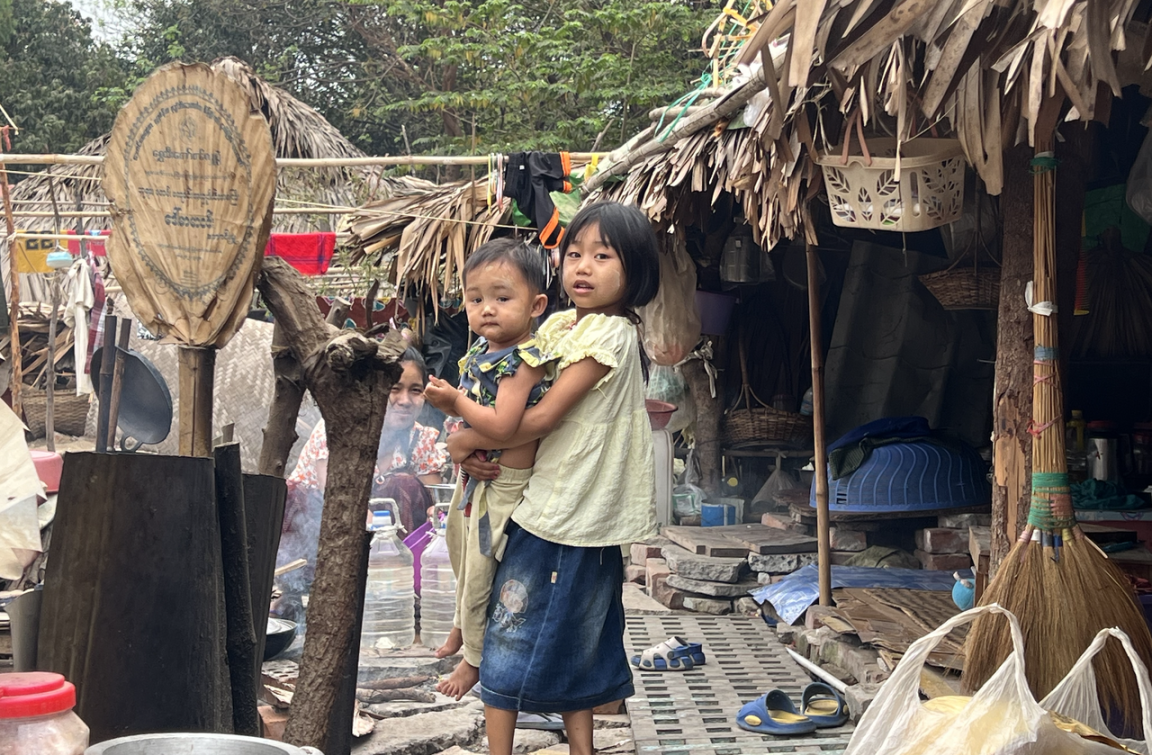
Only heavy manual labor and working in big cities can buy a little more breathing room. Near the famous pagoda in Mandalay, a construction worker laboring under the scorching sun told me his daily wage is 30,000 Kyat (less than 60 Chinese Yuan).
The income of ordinary people is firmly pinned in place. In Myanmar, locals generally cannot afford to drink bottled water. Because just 5 bottles of the most ordinary mineral water can instantly drain the entire day's wages earned through hard work by an adult.
Myanmar Children, Already Reduced to the "Working Class"
When the meager wages of adults are squeezed dry by inflation, the heavy pressure of survival inevitably falls on the next generation.
In Bagan, Kosla calmly recalled his childhood to me. To survive, he started working in a restaurant at the age of 9. Toiling from 8 a.m. to 5 p.m., he earned a daily wage of 500 Kyat. It wasn't until he was 16 that this wage艰难地爬升到了 (painfully climbed to) 2500 Kyat.
This is not just Kosla's personal时代眼泪 (tears of the times), but the至今触目惊心的 (still shocking today)底色 (underlying tone/reality) of this country.
Traveling from Yangon and Bagan to the largest northern city, Mandalay, "prematurely matured childhoods" are the most common sight on the streets.
In the middle of Yangon's traffic-congested roads, boys under 15 hold their four or five-year-old brothers, begging by knocking on car windows amidst exhaust fumes and danger;
In Bagan, children under 10 do odd jobs in restaurant kitchens, underage waiters熟练地 (skillfully) serve dishes and water, and beside those ancient pagodas, groups of teenagers can only earn meager change by taking photos for tourists; outside temples in Mandalay, children around 10 years old are busy helping their parents with incense and offerings.
Time seems to stand still here. More than a decade has passed, whether in remote villages or core cities, the situation seems unchanged. In this country, childhood is a luxury. Young children are thrown early into the cruel game of survival, still the heaviest and unsolvable daily reality of Myanmar.
Myanmar Youth, A Generation Unable to Redeem Themselves
And when these prematurely matured children grow up, what awaits them is another inescapable cage. For ordinary Myanmar youth, leaving is an exorbitantly expensive redemption.
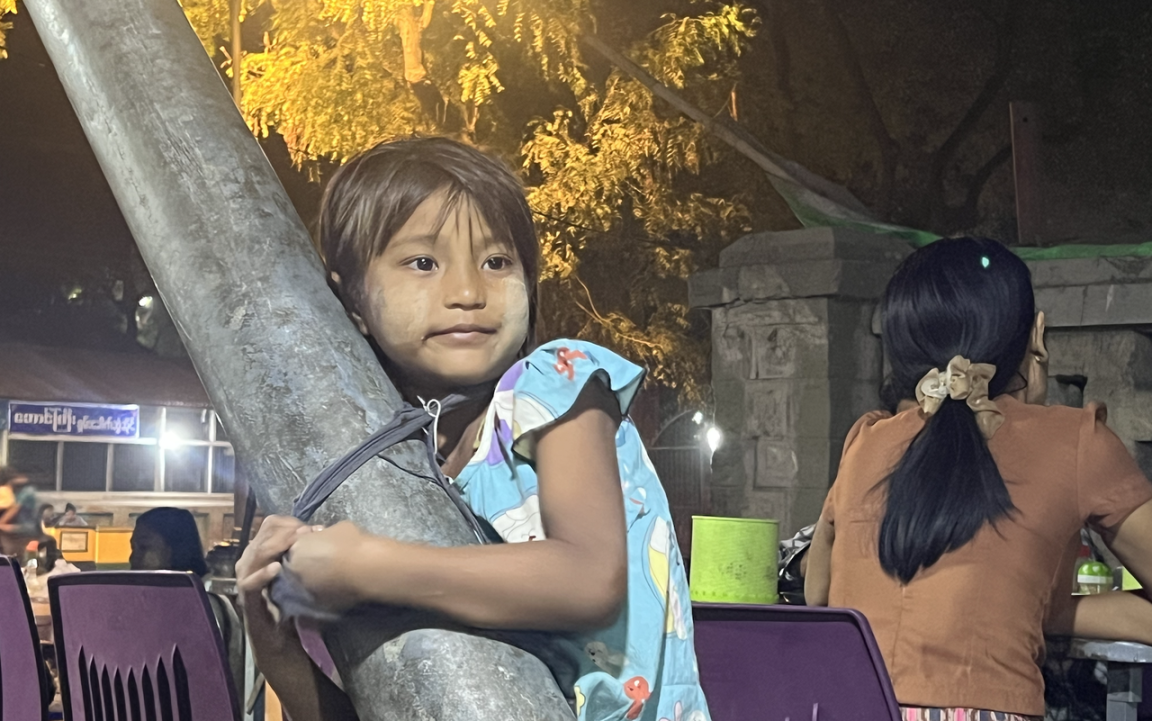
First are the economic shackles. Meager wages are like stagnant water; merely coping with soaring living costs exhausts all their strength, making "saving money to go abroad" a distant, unattainable luxury.
And the iron fist of power directly severs the legal escape route for this generation. "If you are over 80 years old, you can leave Myanmar freely; but if you are between 18 and 60 years old, the country will absolutely not let you go." A老板 (boss/owner) in Yangon, Veraswami, told me this cruel unwritten rule. The government strictly controls youth出境 (exiting the country), making passports meaningless.
When normal channels are completely blocked,畸形 (deformed/malformed) "ways out" begin to滋生 (breed/grow) in the shadows.
"Now many people specifically come to Myanmar to 'buy wives'." Boss Veraswami shared a recent incident he handled with a bitter smile: To help the Myanmar wife of a foreign man leave the country smoothly, he疏通 (greased the wheels), paid various facilitation fees totaling 3000 Chinese Yuan. For a foreigner, 3000 Yuan might be just an ordinary plane ticket; but for the底层 (bottom/underclass) Myanmar people, it is the entire life's earnings of an ordinary person working diligently for 15 months without eating or drinking.
Even risking their lives to work illegally, the reality is equally绝望 (hopeless). A Myanmar monk无奈地 (helplessly) told me that many young people try to偷渡 (sneak across the border) to Thailand by water. But as border hostilities spread, Thailand not only does not welcome Myanmar refugees but has also begun strictly investigating and cracking down on the employment of Myanmar illegal workers.
Can't leave, can't stay. The national border here is no longer a dotted line on the map, but an abyss cast from absolute power and extreme poverty.
Final Words
The镜头定格 (lens focuses) on a little boy quietly looking out the train window.
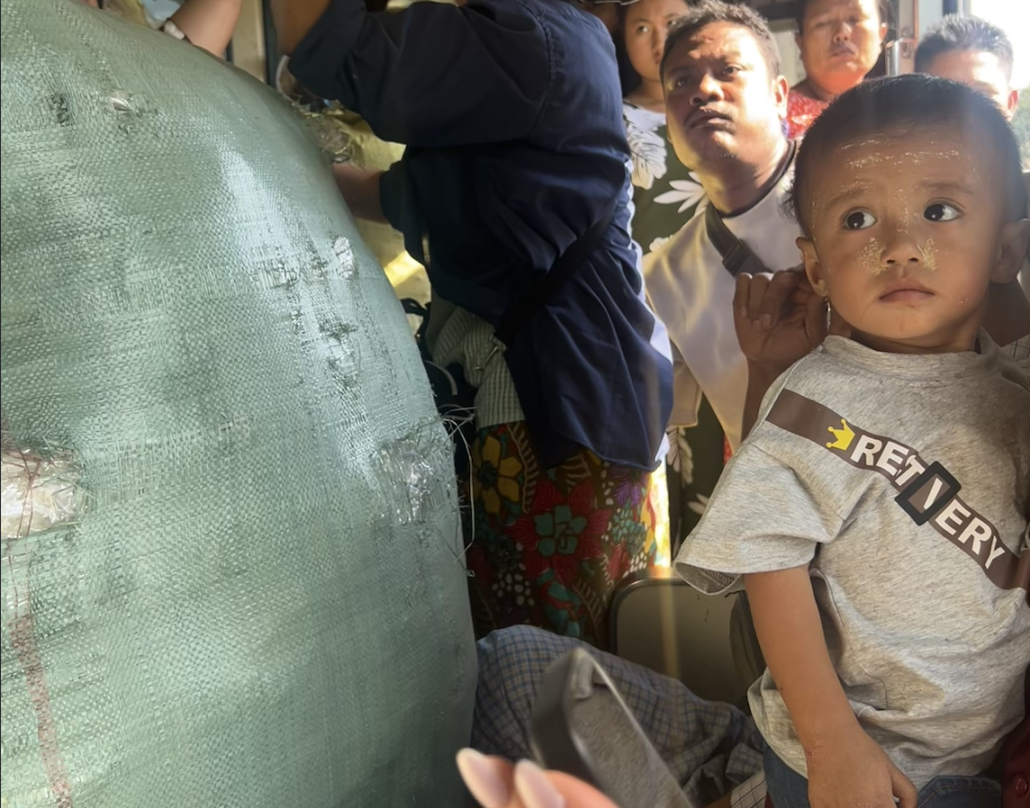
A Myanmar boy on the train
He is an缩影 (epitome) of the millions of ordinary boys in Myanmar. Time will irreversibly push him forward, making him grow into a youth, then a man, eventually, inevitably becoming someone like my guide, Kosla.
I once asked this ordinary Myanmar man: "Are you happy?" Kosla didn't answer immediately. When I追问 (pressed) a second time, he only避重就轻 (evaded the important point) saying: "We are busy with making a living every day, we simply have no time to think about happiness."
Until much later, on the dusty roadside, he answered this question for the third time, and most completely:
"I might die tomorrow. They could grab me to become a soldier at any time, to go fight on the other side of the river. After 7 p.m., if a man is on the street in Bagan, he will likely be thrown in jail, then sent to the battlefield for no reason. I've been working since I was 9 years old, but the speed of wage increases can never catch up with inflation."
"A lifetime. No happiness." He said.
Twitter:https://twitter.com/BitpushNewsCN
Bitpush TG Discussion Group:https://t.me/BitPushCommunity
Bitpush TG Subscription: https://t.me/bitpush